<img height="1" width="1" style="display:none;" alt="" src="https://dc.ads.linkedin.com/collect/?pid=318106&amp;fmt=gif">
Skip to content
spaceshuttle

Treasury

What Is a Treasury Management and Trading System for Banks?


The treasury and trading function is central to how a bank manages its liquidity, funding, market activity, and financial risk. Treasury ensures the institution can meet its obligations at all times, while trading activity supports funding, investment, hedging, and customer-driven market transactions. Together, these functions provide the visibility, control, and discipline needed to manage the bank’s balance sheet, respond to changing market conditions, and operate within defined risk appetite and trading policy. 

Because of this, the platforms that support treasury and trading are not simply processing tools. They are essential control environments that help banks manage liquidity in real time, monitor exposures, enforce limits, and connect strategic intent with day-to-day execution.

The Role of Treasury Systems in Modern Banking

Treasury functions are central to the safe and effective bank operations. Treasury Management systems provide a transparent, real time view point that enables treasurers to proactively manage the banks positions and action their responsible in ensuring that the institution can meet its financial obligations at all times, manage its funding efficiently, and maintain an appropriate balance between risk and return.

These responsibilities are inherently complex. A bank’s balance sheet is constantly evolving, influenced by customer activity, market movements, regulatory changes, and internal strategic decisions. Without a central system to manage these dynamics, institutions would struggle to maintain a timely, consistent and accurate view of their financial positions and obligations.

A Treasury Management and Trading System addresses this challenge by acting as a single source of truth for financial positions and exposures. It consolidates data from across the organisation, normalises it, and presents the data in a format that supports both operational management and strategic decision-making.

Centralisation of this positional data is critical. In its absence, banks risk operating without a clear, transparent view, relying on fragmented data, inconsistent assumptions, and delayed insight. These risks are amplified in fast-moving markets, where timing and accuracy are essential.

Beyond data consolidation, treasury systems also serve as the operational link between high-level governance frameworks and front-office activity. Decisions made at board or executive level, such as defining risk appetite or setting trading policy, must ultimately be reflected in the control environment of traders and treasury teams. Without system-level control functionality, the operation leaves itself exposed to material risk events crystalising.

Modern treasury systems, including those architected in environments like Siena, are therefore designed not just to enable activity, but to ensure that it operates within defined control parameters appropriately. They ensure that every action taken within the system is consistent with the organisation’s broader objectives and defined risk tolerances.

Considering a new Treasury Management System?
Core Functions and Features

Real-Time Cash and Position Management
hero-image


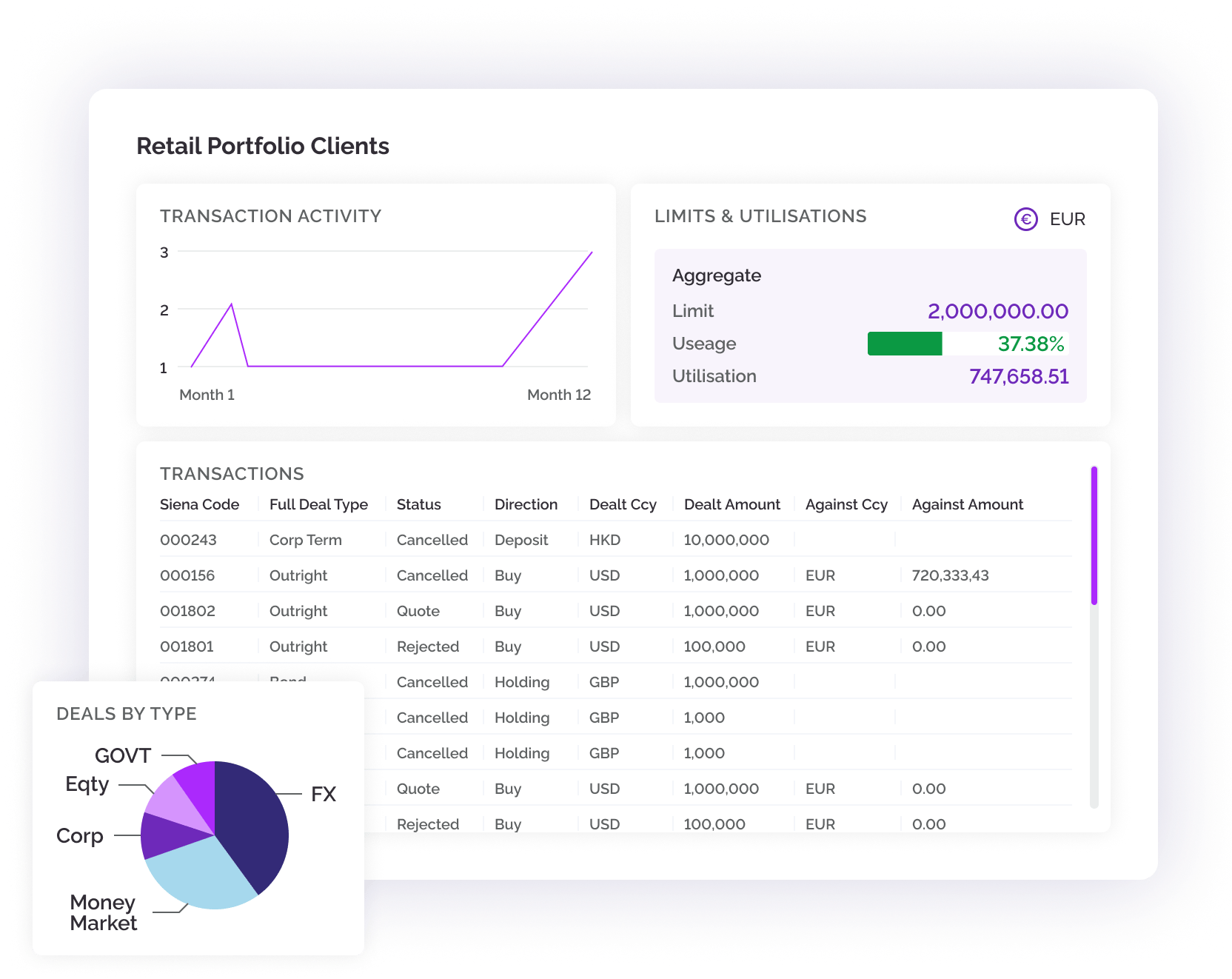
This real-time visibility is particularly critical in environments characterised by volatility or stress. In such conditions, delays in information can lead to reactive or delayed decisions, which in turn can exacerbate risk. By contrast, immediate access to accurate data enables proactive management, adjusting funding strategies, reallocating resources, and mitigating potential issues before they escalate.

Moreover, real-time position management supports more sophisticated liquidity forecasting. By combining current positions with predictive models, banks can anticipate future funding needs and plan accordingly. This capability is increasingly important as regulators demand more granular oversight of liquidity risk.

Within platforms such as Siena Treasury Manager, this capability is not only about speed but also about confidence. The system must ensure that the data being presented is accurate, consistent, and auditable, particularly in environments where trust in underlying systems may be challenged.

One of the most fundamental capabilities of any treasury system is the ability to provide real-time visibility into cash flows, cash balances and positions across the organisation. This capability allows banks to understand, at any given moment, where their liquidity sits, how it is being utilised, and where potential risks may be emerging.

Rather than relying on batch updates or end-of-day reconciliation, modern treasury platforms continuously process streams of transactional data. This ensures that balances and exposures are always current. This view allows treasury teams to time and head space to make the most efficient, informed decisions immediately to actively manage and control changes in liquidity conditions.


benefits-image


Deal Capture and Trade Lifecycle Management

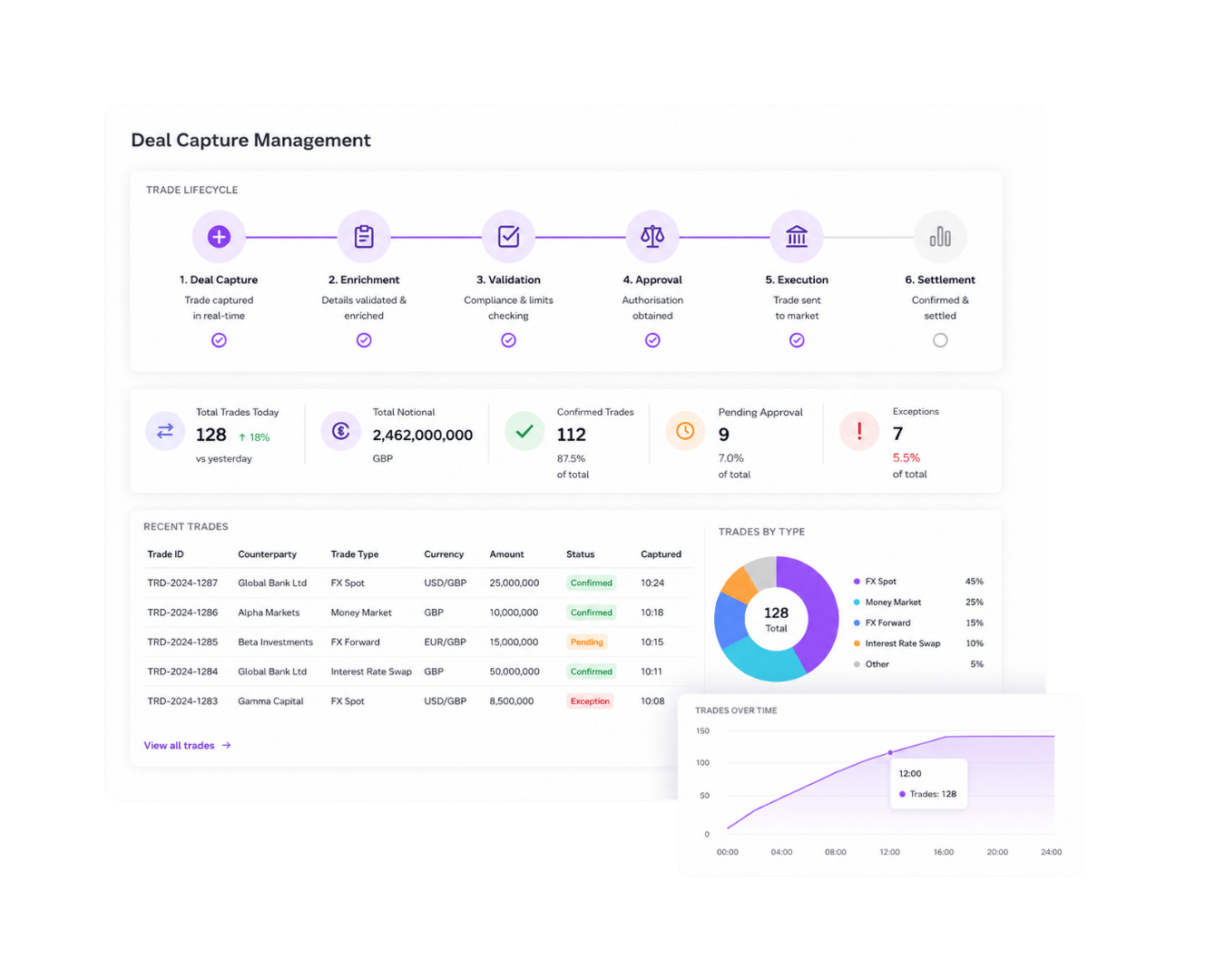
Treasury systems are designed to manage the complete lifecycle of financial transactions, providing a coherent framework for handling complex instruments across multiple markets. From the initial capture of a deal through to settlement and post-trade processing, the system ensures that each stage of the lifecycle is handled consistently and in line with defined rules.

This capability encompasses a broad range of instruments, including money market products, bonds, foreign exchange transactions, and derivatives such as interest rate swaps, cross-currency swaps, and FX options. These instruments support a variety of treasury activities, from funding and investment to the management of interest rate and currency exposures. Each carries its own complexities, including valuation models, settlement processes, and distinct risk characteristics, all of which must be handled consistently within the system.

For many institutions, these instruments also play a role in broader hedging strategies, where exposures are actively managed to reduce volatility. In these cases, treasury systems must provide sufficient structure to ensure that trades, valuations, and associated accounting treatments remain aligned, supporting consistent financial reporting without introducing unnecessary operational burden.
Siena Treasury Pillar Page Graphics


Siena Treasury Pillar Page Graphics (1)

By centralising these activities within a single platform, treasury systems eliminate fragmentation and reduce operational complexity. Traders and treasury staff can operate within a unified environment where hedging strategies, trade execution, valuation, and hedge accounting are all aligned. This removes the need to switch between systems or solely rely on manual reconciliation, ensuring that both risk management and financial reporting remain consistent, auditable, and tightly controlled.

Importantly, this lifecycle management is closely integrated with risk and control frameworks. Every trade captured within the system is subject to validation, ensuring that it complies with defined policies and limits. This ensures that control is embedded directly into execution, rather than applied retrospectively.

A complete and auditable record of each transaction is maintained, supporting both internal governance and external regulatory requirements. This traceability is essential in demonstrating that processes are functioning as intended and that controls are being applied consistently.


Explore the Future of Electronic Trading.
Untitled design (39)

Limit Monitoring, Risk Appetite, and Real-Time Control 

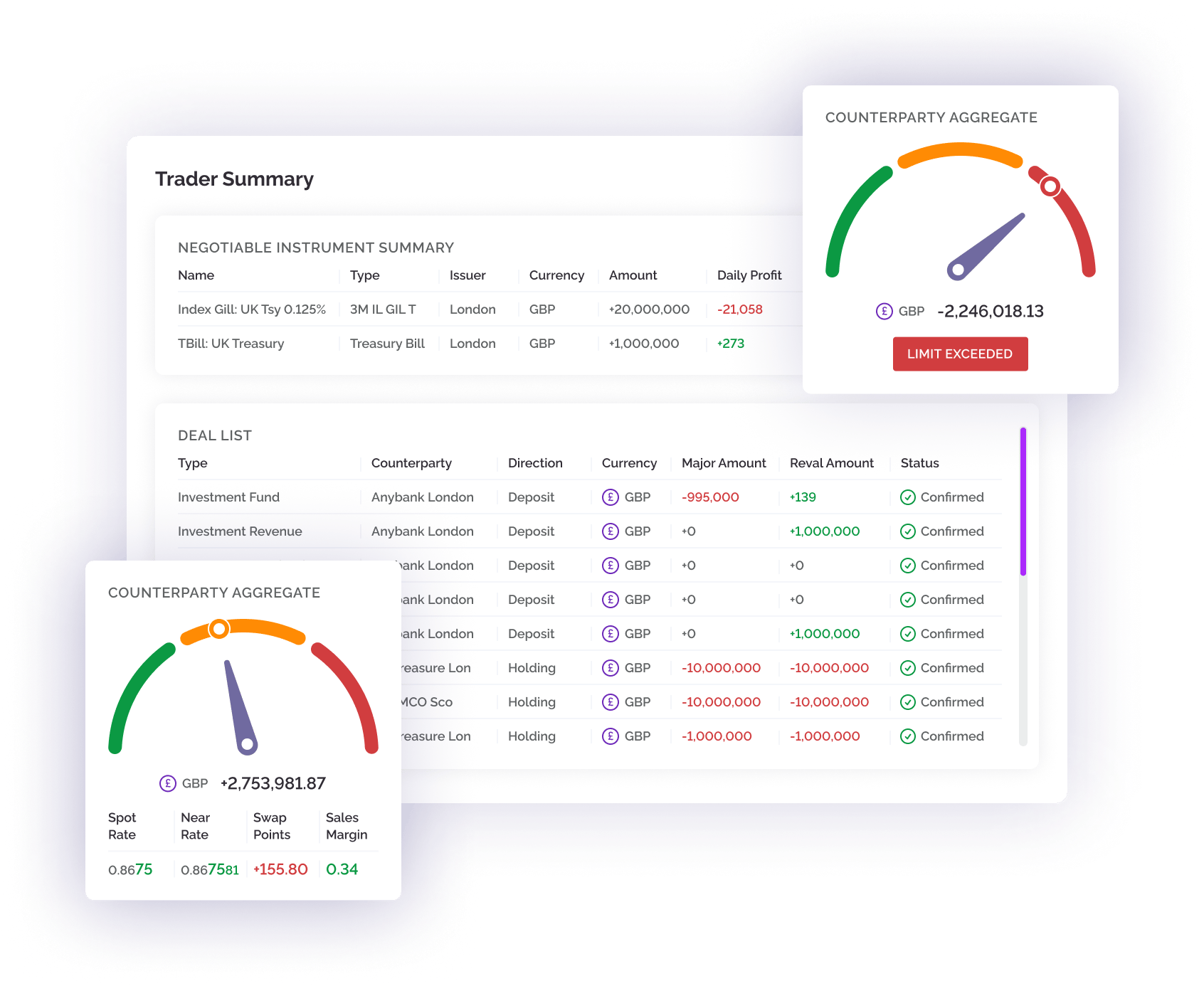
Risk management within treasury systems is primarily achieved through the implementation of limit frameworks. These limits define the boundaries within which the bank is willing to operate, covering exposures across counterparties, countries, asset classes, and individual traders.

However, in modern systems, limits are no longer static thresholds defined in isolation. They are increasingly derived directly from the bank’s broader risk appetite statement, creating a structured and traceable relationship between strategy and execution.

A well-constructed Treasury management solution enables the link between risk appetite and operational execution. Comprehensive limit management provides a control element across both credit and operational risk perspectives; these allow close pre-deal validation ensuring that transactions are checked against the defined limits before they are executed. This shifts risk control from a reactive process to a preventative one, reducing the likelihood of breaches and strengthening governance providing continuous visibility into limit utilisation, allowing both front-office and risk teams to monitor exposures as they evolve. This transparency is critical for informed decision-making and effective oversight.


Untitled design (41)

Anchoring the Risk Appetite Statement in Daily Operations 

A bank’s risk appetite statement defines the level and type of risk it is willing to accept in pursuit of its strategic objectives. While this is typically established at board or executive level, its effectiveness depends entirely on how well it is embedded within day-to-day operations.

Treasury and trading systems play a central role in this embedding process.

Rather than treating risk appetite as a static reference point, modern systems enable it to function as a live control framework. Real-time monitoring capabilities ensure that key metrics, such as liquidity positions, market exposures and volatility are continuously measured against defined thresholds.

This ensures that risk appetite is not assessed retrospectively but actively influences behaviour as it happens.

Furthermore, risk appetite is operationalised through structured limit hierarchies. These limits cascade from board-level tolerances down to desks, portfolios, and individual traders. Every transaction is therefore assessed within the context of the institution’s overall risk strategy.

Advanced systems also support forward-looking risk management through stress testing and scenario analysis. By modelling the impact of adverse conditions on key metrics, banks can anticipate potential breaches of risk appetite and adjust their strategies proactively.

In this way, the treasury system becomes the mechanism through which risk appetite is not only defined, but continuously applied, monitored, and refined.

Anchoring the Risk Appetite Statement in Daily Operations 

A bank’s risk appetite statement defines the level and type of risk it is willing to accept in pursuit of its strategic objectives. While this is typically established at board or executive level, its effectiveness depends entirely on how well it is embedded within day-to-day operations.

Treasury and trading systems play a central role in this embedding process.

Rather than treating risk appetite as a static reference point, modern systems enable it to function as a live control framework. Real-time monitoring capabilities ensure that key metrics, such as liquidity positions, market exposures and volatility are continuously measured against defined thresholds.

This ensures that risk appetite is not assessed retrospectively but actively influences behaviour as it happens.

Furthermore, risk appetite is operationalised through structured limit hierarchies. These limits cascade from board-level tolerances down to desks, portfolios, and individual traders. Every transaction is therefore assessed within the context of the institution’s overall risk strategy.

Advanced systems also support forward-looking risk management through stress testing and scenario analysis. By modelling the impact of adverse conditions on key metrics, banks can anticipate potential breaches of risk appetite and adjust their strategies proactively.

In this way, the treasury system becomes the mechanism through which risk appetite is not only defined, but continuously applied, monitored, and refined.

Untitled design (45)
Strengthen Governance, Risk and Compliance

Embedding Trading Policy Through Operational Controls

A bank’s trading policy defines what can be traded, by whom, and under what conditions. However, without system-level enforcement, these rules risk becoming theoretical rather than practical.

Treasury systems address this challenge by embedding trading policy directly into their control frameworks.

Permissions structures define which instruments, markets, and asset classes each trader can access. These permissions are aligned with both organisational policy and regulatory requirements, ensuring that trading activity is inherently compliant.

At the same time, trader-level limits reflect both risk appetite and individual mandates. These limits may vary based on experience, role, or strategic objectives, creating a tailored framework for each participant in the trading process.

Pre-trade validation ensures that every transaction adheres to both policy and risk appetite constraints. Non-compliant trades are alerted pre-execution and are either blocked or escalated through defined governance processes, ensuring that exceptions are managed appropriately.

Crucially, all aspects of policy implementation are fully auditable. Changes to permissions, limits, and configurations are recorded, along with approval workflows and historical states. This provides a clear and defensible record of how policy is enforced in practice.

Enabling the Three Lines of Defence

The Three Lines of Defence model provides a structured approach to risk governance, ensuring that responsibilities are clearly defined and appropriately segregated.

Treasury systems support this model by providing a shared platform through which all three lines can operate and interact.

For the first line, comprising treasury and trading teams, the system provides the tools and controls needed to operate within defined boundaries. Real-time visibility and embedded constraints ensure that activity remains aligned with both risk appetite and trading policy.

For the second line, including risk and compliance functions, the system provides independent monitoring capabilities. Dashboards, alerts, and reporting tools enable these teams to assess adherence to policy, identify emerging risks, and intervene where necessary.

For the third line, internal audit, the system provides a complete and immutable record of activity. Historical data, audit trails, and documentation allow auditors to assess the effectiveness of controls and verify that governance frameworks are functioning as intended.

By supporting all three lines within a single, integrated environment, treasury management systems reduce fragmentation and enhance the overall effectiveness of risk governance.

Breaking Silos Between Risk Appetite, Policy, and Execution

One of the most significant benefits of modern treasury systems is their ability to eliminate silos between different aspects of financial management.

Historically, risk appetite, trading policy, and execution have often been managed separately, leading to inconsistencies and gaps in control. Modern platforms address this by integrating these elements within a single framework.

This integration ensures that all stakeholders—treasury, risk, finance, and front office—operate from a consistent set of data and assumptions. It also ensures that strategic frameworks are directly reflected in operational behaviour.

The result is a more coherent and controlled environment, where decisions are aligned, risks are visible, and actions are consistent with organisational objectives.

Supporting Resilience in an Adversarial Environment

As the operating environment for banks continues to evolve, resilience has taken on a new meaning. It is no longer sufficient for systems to recover from outages or failures. They must also be capable of operating in conditions where trust is uncertain—where data, systems, or identities may be compromised.

Treasury systems play a critical role in this new model of resilience.

By providing real-time visibility, enforcing controls, and ensuring auditability, they enable banks to maintain continuity even under adverse conditions. The integration of risk appetite, trading policy, and execution within a single platform further enhances resilience by reducing complexity and increasing transparency.

Platforms developed within the Siena ecosystem increasingly reflect this shift, recognising that resilience is not just about recovery, but about maintaining control, confidence, and operational integrity in the face of uncertainty.

Ready to Transform Your Treasury Operations?
webinar-03-unsplash

Conclusion

A Treasury Management and Trading System is no longer just an operational necessity—it is a strategic platform that underpins how banks manage risk, enforce governance, and operate in complex and uncertain environments.

By embedding risk appetite into real-time controls, translating trading policy into enforceable rules, and supporting the Three Lines of Defence, these systems ensure that strategy, policy, and execution are fully aligned.